

Lunit INSIGHT Breast Suite (MMG and DBT)
AI for accurate and efficient breast cancer detection
Lunit Insight Breast Suite, a strongly validated AI built for clinical confidence: Lunit is among the most extensively validated AI technologies in breast imaging, supported by more than 95 independent peer-reviewed studies across diverse clinical settings. Designed to support radiologists in routine practice, the solution focuses on delivering consistent, clinically relevant outputs that integrate naturally into the reading workflow. By combining advanced detection capabilities with transparent AI confidence scoring and intuitive visual support, Lunit helps prioritize meaningful findings while maintaining a high level of interpretability. This approach enables radiologists to leverage AI as a reliable companion, supporting confident and efficient decision-making in daily breast cancer screening practice.
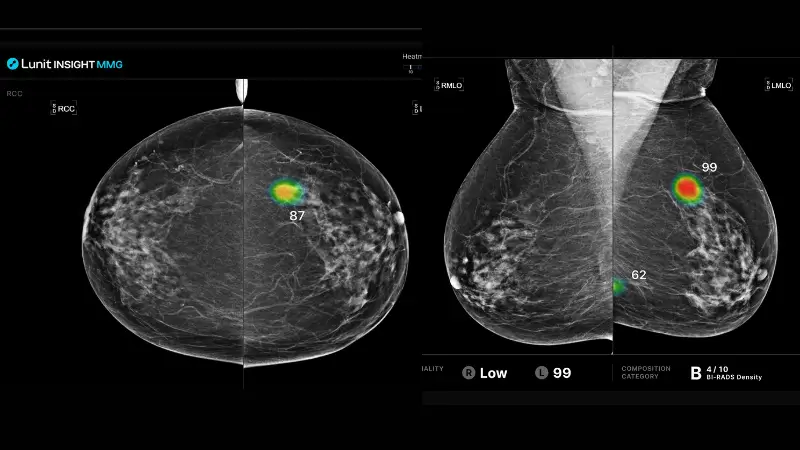
Advanced Lesion Detection
Detection of masses, asymmetries, architectural distortions and calcifications to support early and reliable identification of breast abnormalities. Heatmap or contour visualization highlights suspicious regions directly on images, enhancing interpretability. The prior comparison feature enables analysis against previous examinations for improved assessment.
AI Abnormality Score
Trained to identify malignancy‑associated findings and prioritize clinically relevant detections, Lunit assigns abnormality scores at both the breast and lesion level. These scores quantify the likelihood of malignancy for each suspicious lesion.
Density Decision Support
Lunit INSIGHT provides automated breast density assessment (based on BI-RADS).
Seamless Workflow Integration
Seamless integration across modalities, PACS, and reading workflows, enabling effortless adoption without disrupting clinical practice.
Increase cancer detection rates by up to 10%, while maintaining high sensitivity, including in dense breast tissue.
Up to 94% reduction in false positive markings compared to traditional CAD, supporting clearer interpretation and reducing unnecessary recalls.
Reduce reading time by up to 36% in normal cases, helping radiologists optimize workflow and focus on high-priority exams.
Save time, secure your diagnosis and optimize your workflow with Incepto
Publications
-
Dembrower, K., Crippa, A., Colón, E., Eklund, M., Strand, F., & ScreenTrustCAD Trial Consortium (2023). Artificial intelligence for breast cancer detection in screening mammography in Sweden: a prospective, population-based, paired-reader, non-inferiority study. The Lancet. Digital health, 5(10), e703–e711.
-
Chang, Y. W., Ryu, J. K., An, J. K., Choi, N., Park, Y. M., Ko, K. H., & Han, K. (2025). Artificial intelligence for breast cancer screening in mammography (AI-STREAM): preliminary analysis of a prospective multicenter cohort study. Nature communications, 16(1), 2248.
-
Larsen, M., Olstad, C. F., Lee, C. I., Hovda, T., Hoff, S. R., Martiniussen, M. A., Mikalsen, K. Ø., Lund-Hanssen, H., Solli, H. S., Silberhorn, M., Sulheim, Å. Ø., Auensen, S., Nygård, J. F., & Hofvind, S. (2024). Performance of an Artificial Intelligence System for Breast Cancer Detection on Screening Mammograms from BreastScreen Norway. Radiology. Artificial intelligence, 6(3), e230375.
-
Elhakim, M. T., Stougaard, S. W., Graumann, O., Nielsen, M., Gerke, O., Larsen, L. B., & Rasmussen, B. S. B. (2024). AI-integrated Screening to Replace Double Reading of Mammograms: A Population-wide Accuracy and Feasibility Study. Radiology. Artificial intelligence, 6(6), e230529.
-
Nanaa, M., Gupta, V. O., Hickman, S. E., Allajbeu, I., Payne, N. R., Arponen, O., Black, R., Huang, Y., Priest, A. N., & Gilbert, F. J. (2024). Accuracy of an Artificial Intelligence System for Interval Breast Cancer Detection at Screening Mammography. Radiology, 312(2), e232303.
-
Dembrower, K. E., Crippa, A., Eklund, M., & Strand, F. (2025). Human-AI Interaction in the ScreenTrustCAD Trial: Recall Proportion and Positive Predictive Value Related to Screening Mammograms Flagged by AI CAD versus a Human Reader. Radiology, 314(3), e242566.
-
van Winkel, S. L., Sechopoulos, I., Rodríguez-Ruiz, A., Veldkamp, W. J. H., Gennaro, G., Chevalier, M., Helbich, T. H., Zhang, T., Wallis, M. G., & Mann, R. M. (2025). An Exploration of Discrepant Recalls Between AI and Human Readers of Malignant Lesions in Digital Mammography Screening. Diagnostics (Basel, Switzerland), 15(12), 1566.
-
Brown-Mulry, B., Isaac, R.S., Lee, S.H. et al. Subgroup performance of a commercial digital breast tomosynthesis model for breast cancer detection. Nat Commun (2026).
-
Park, E. K., Kwak, S., Lee, W., Choi, J. S., Kooi, T., & Kim, E. K. (2024). Impact of AI for Digital Breast Tomosynthesis on Breast Cancer Detection and Interpretation Time. Radiology. Artificial intelligence, 6(3), e230318.
-
Bahl, M., Langarica, S., Lamb, L. R., Kniss, A. S., & Do, S. (2025). AI to Reduce the Interval Cancer Rate of Screening Digital Breast Tomosynthesis. Radiology, 316(1), e241050.
Regulatory
Contact us to know if this product is available in your country.